
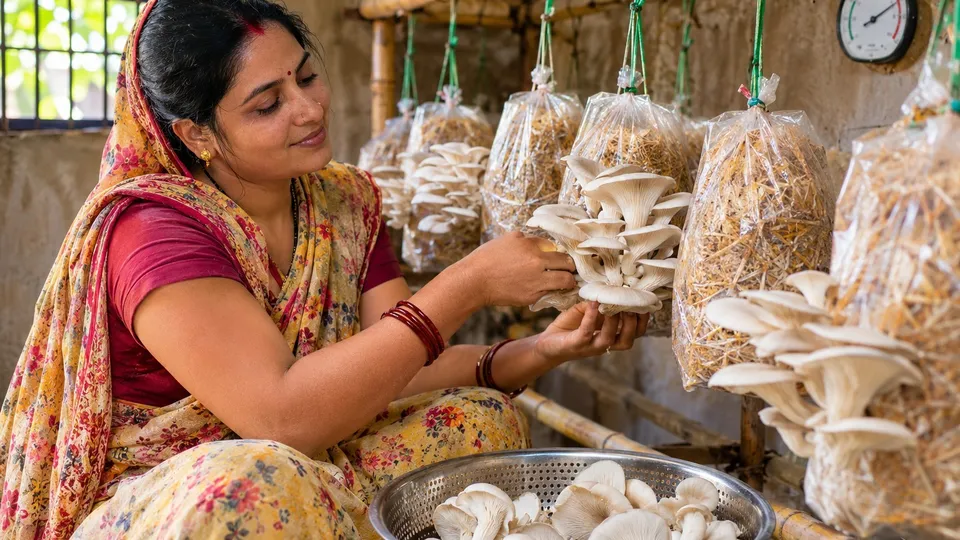
On YouTube you often hear - "₹1 lakh a month from one room". Hearing it, you feel like starting tomorrow itself. But a calculation based on the yield and price data of government institutes (ICAR) says something else: sales of about ₹10,000-18,000 per cycle (45-60 days) from 100 sq ft, and that too before deducting costs.
This does not mean oyster mushroom farming at home is useless. It means you should treat it as a side income and start small and sensibly. This article explains the full working of cost, earnings, method and selling in simple language.
Why oyster (dhingri) mushroom?
Among small-space businesses, oyster mushroom can be considered the most reliable one to start with - if buyers are fixed in advance. Its technology comes from the government institute ICAR-DMR (Solan).
- First harvest: about 20-31 days after adding spawn (seed)
- 3 harvests from one bag: at gaps of 7-10 days
- Yield: about 0.7-1 kg per bag (~5 kg of wet straw in one bag)
- Starting cost: ₹15,000-60,000 (racks, net, drums etc.) - with bamboo racks the setup can be kept around ₹15,000
- Real example: in Gaya (Bihar) a farmer sold at ₹120/kg and NABARD recorded an average profit of about ₹65/kg
How much space do you need to grow mushrooms at home?
100 sq ft means 10×10 ft - roughly a small bedroom. It fits 2 racks with 4-5 tiers each and a walkway in between. Here height is your real land.
- About 60-100 bags in 50 sq ft (estimate)
- About 150-250 bags in 100 sq ft (estimate)
- The room should be shaded and airy; a fine net on the window, an exhaust fan and a thermometer-hygrometer are a must
Which variety to grow in which season?
This is where most people lose - by growing a variety against the season. The wrong variety means empty bags. According to ICAR-DMR, by changing varieties you can grow oyster in the plains of North India from November to April.
| Variety | Right temperature | When |
|---|---|---|
| P. florida | 15-22°C | Winter |
| P. sajor-caju | 18-26°C | March-April |
| Pink P. djamor | - | April in the plains |
If your room goes above 35°C in summer and there is no AC, oyster is not for you in summer. For that season there is the option of milky mushroom, which needs 30-35°C - but if the room crosses 40°C in May-June, even milky gets scorched, and complete beginners should learn oyster first.
How to grow oyster mushrooms at home? (7 steps)
- Choose the variety - from the table above, according to your room's temperature.
- Prepare the straw - soak wheat or paddy straw, then pasteurise it with hot water or steam (to kill germs). Squeeze out the water - not a drop should fall when you press a fistful.
- Fill the bags - in each bag ~5 kg of wet straw and ~3% of that as spawn (i.e. about 150 g), layer by layer. Make small holes in the bag.
- Let it spread in the dark - in 8-10 days the bag fills with white threads (mycelium). Keep light and air low during this time.
- Fruiting time - cut/open the bags. 23-25°C temperature, 80-85% humidity, 3-4 hours of soft light a day and fresh air. Spray water on the walls and floor, not on the mushrooms.
- Pick and sell immediately - twist and pick before the cap edges curl. Fresh mushrooms stay good for only 1-2 days.
- Remove the bags after 3 harvests - the leftover straw is useful for vermicompost. Clean the room and start the next cycle.
| What is needed at fruiting | Right range | If too low or too high |
|---|---|---|
| Room temperature | 23-25°C (varies by variety) | Pins (tiny buds) do not form |
| Humidity in the air | 80-85% | Caps dry out and edges crack |
| Light | 600-1000 lux, 3-4 hours a day | Pins do not form |
| Fresh air (CO₂) | Below 500 ppm | Long stalk, small cap |
How much does oyster mushroom farming cost?
- Spawn (seed): about ₹100/kg (ICAR-IIHR, 2023)
- Ready bags for learning: ₹40 (1 kg) and ₹60 (2 kg) - IIHR
- Straw, polythene, fuel, electricity: about ₹3,000-6,000 per cycle for 100 bags (estimate)
- Racks, sprayer, fan, net, thermometer: one-time cost, within ₹15,000-60,000 (estimate)
How much can you earn in one cycle?
The calculation below assumes direct sale at ₹100-120/kg. Think about wastage, your own labour and travel costs separately. All of these are estimates - they will change with your area, season and buyer.
| Calculation (one cycle) | Small: 50 sq ft, ~60 bags | Full: 100 sq ft, ~150 bags |
|---|---|---|
| Yield | 42-60 kg | 105-150 kg |
| Sales | ₹4,200-7,200 | ₹10,500-18,000 |
| Input cost | − ₹1,800-3,600 | − ₹4,500-9,000 |
| In hand | ≈ ₹600-5,400 | ≈ ₹1,500-13,500 |
Recovery: a ₹15,000 bamboo-rack setup can pay for itself in about 2-5 good cycles, while a ₹60,000 setup may take 6-20 cycles. Without AC, about 4-6 cycles a year and ~500-700 kg of yield are estimated. So the cheaper the setup, the better.
Understand the price ladder: in a Haryana mandi (October-December 2025) prices ranged from ₹40-160/kg, i.e. they swung 4-fold within two months. The ICAR-DMR Solan counter (February 2025) sells fresh mushrooms at ₹100/kg. Dried oyster sells at ₹1,000/kg, but remember - 8-10 kg of fresh makes 1 kg of dried.
Where and how to sell mushrooms?
Fresh mushrooms last only 1-2 days, so a crop without a buyer = waste. That is why fixing 3 firm buyers before filling the first bag is the most important rule.
- Hotels, dhabas, restaurants: fixed days each week, fixed quantity - never late, not even once
- Vegetable sellers/carts: 1-2 kg daily, lower price but a sure sale
- Society WhatsApp groups: 200 g packs, order in the morning, delivery in the evening
- Leftover stock: dry it or make pickle (according to ICAR-DMR, pickle lasts about 1 year, soup mix 90 days) - but this needs FSSAI registration and a label
An easy way to get your first customer: give a free 500 g sample, say "every Tuesday and Friday, this much quantity, at this price", do not be late even one day in the first 2 weeks, and from the third week confirm orders in writing.
Where do people go wrong?
- Growing a variety against the season - the biggest reason
- Poor pasteurisation - green/black spots in the bag (green mould, Trichoderma). Take such a bag out of the room immediately
- No fresh air - rising CO₂ gives long stalks and small caps
- No net on the window - small flies
- Water directly on the mushrooms - mushrooms turn yellow and sticky
- Poor or old spawn - according to ICAR-DMR (2023), straw or liquid spawn gave 9-14% less yield than grain spawn
- Growing first, looking for buyers later
How to start - without sinking your money
- Call your district's Krishi Vigyan Kendra (KVK) or RSETI - they often have free or low-cost training. The 5-day course at ICAR-DMR Solan costs ₹7,500 (2024-25 calendar).
- Write down the names of 20 possible buyers and meet 10 of them - "Where do you buy from now, at what price, and how much per week?"
- Only after getting 3 firm "yes" answers, do a small trial of 20-30 bags - only from savings, not from loans.
- Write a "stop line" in advance - like "If I don't get 3 firm buyers in 2 cycles, I will stop."
- Fill the full 100 sq ft only when 2 cycles in a row sell out.
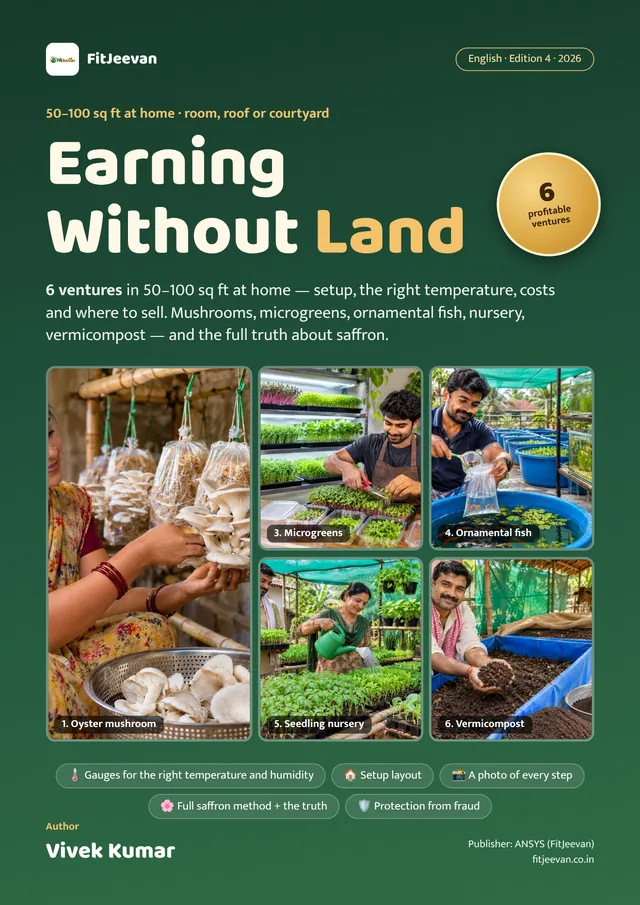
The full working for milky mushroom, vermicompost and the other 3 businesses, a temperature gauge, a 90-day plan and the full list of scams are in the book "Earning Without Land". But to start, remember just this: small, sure and written down - that is the real earning in this work.
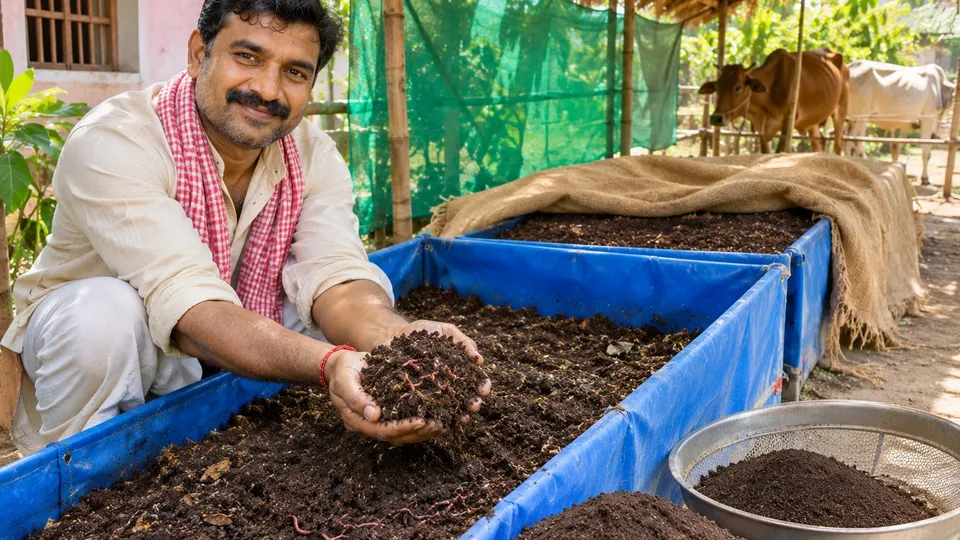 How to Make Vermicompost at Home and Sell It: Method, Cost, Earnings
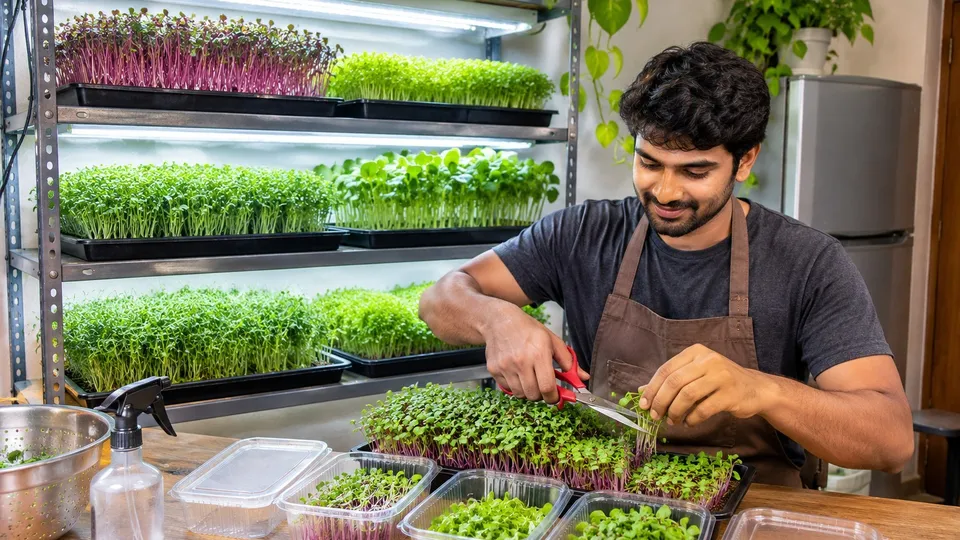 Microgreens Business: Start in 1 Room, Costs and Real Earnings
 Ornamental Fish Farming at Home: How to Start, Cost & Real Income
