
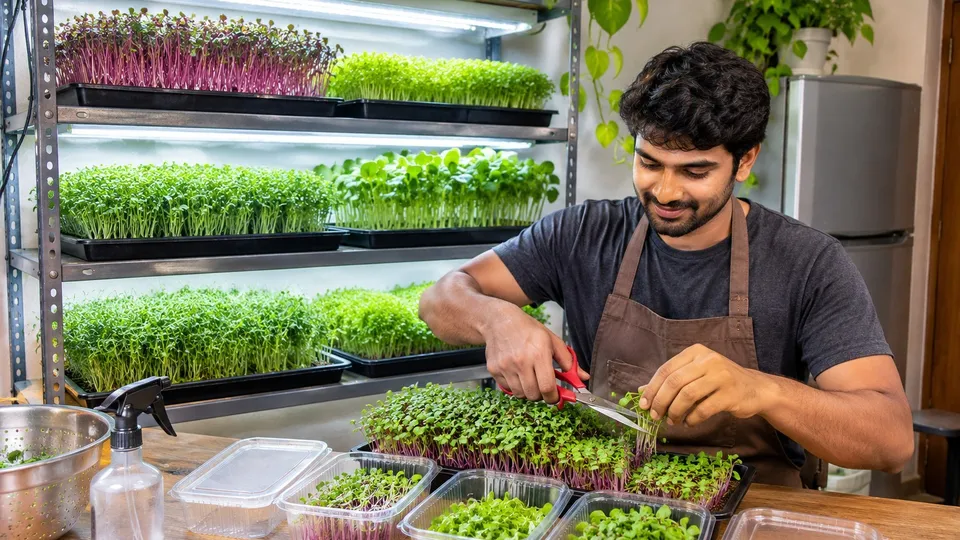
"₹5 lakh a month from 80 sq ft" - you must have heard this line about microgreens in some video. But look at the same entrepreneur's full story: a 64 sq ft room, a start with ₹5 lakh of savings, and today 5 employees, 25 sales channels and 30+ franchises.
And their FY24 turnover was ₹40 lakh - sales and training put together. That means about ₹3.3 lakh a month in sales, not profit. So before you start a microgreens business, you need to know the real numbers - and that is what this article gives you.
What are microgreens?
Seeds of radish, mustard, methi (fenugreek), moong, sunflower or peas are sown thickly in trays and (for seeds like radish and mustard) cut with scissors in 8-12 days, before or around the time the first true leaf appears. Cafés and restaurants use them in salads and as garnish.
Will a microgreens business work in your city?
This is the most important question. Microgreens prices and buyers are mostly in big cities. In a small town or village, you will find very few people who will pay ₹100 for 50 grams.
- Who it is for: people living in a metro or big city; those with contacts in cafés, gyms, among dietitians or in upmarket housing societies; those who can deliver every day
- Who it is not for: small towns/villages where no one will buy at this price; those who have no fridge or cool place
What will a 1-room setup look like?
An entrepreneur in Kochi set up 4 racks in just 64 sq ft. So a small room or a corner is enough - only light and a fan are a must.
- A 3-4 shelf rack, with an LED tube light on each shelf
- Trays with holes, and a tray below for watering from the bottom
- A small fan - keep the air moving so that mould does not grow
- A table for harvesting and packing, ventilated boxes
- A small fridge - to keep the produce at 4°C
How to grow microgreens? (7 steps)
- Choose seeds - radish, mustard, methi, moong, sunflower, peas. Take only untreated seed (no chemical coating) - chemically treated seed is not fit to eat.
- Tray and medium - cocopeat or tissue paper in a tray with holes.
- Sow thickly - the quantity is in the table below.
- 2-3 days of darkness - place another tray on top and press down, so the sprouts come up evenly.
- Give light - window light or LED. Water lightly, and from below.
- Cut in 8-12 days - with clean scissors, before or around the first true leaf.
- Pack - dry them, put them in ventilated boxes, keep at 4°C. Same-day delivery is best.
| Seed (30×24 cm tray) | Seed per tray | Harvest |
|---|---|---|
| Small seeds (mustard, cabbage) | 3-4 g | 8-12 days (radish, mustard) |
| Medium seeds (radish, methi) | 8-10 g | 8-12 days (radish) |
| Moong | About 25 g | Depends on the seed |
These figures are from a DRDO-DIHAR study (ICAR "Indian Farming", 2019). One tray can give about 30-150 grams of produce, depending on the seed.
What does a microgreens business cost?
- Tray: about ₹60 (2019 price)
- Medium (cocopeat/tissue): about ₹16 per tray (2019); seed + medium together ~₹23 per tray
- Seed: retail packs of 25-50 g for ₹59-70 - much cheaper in bulk
- 30-tray mini greenhouse (DIHAR model): ₹12,800 (2019)
- Racks and LED: no reliable Indian price found - ask in your local market
For a first trial, 5-10 trays are enough. You do not need an expensive setup from the first day.
How much can you earn from 1 room?
The calculation below is an estimate - it will change with your location, city and buyers. Think separately about the cost of packing, petrol, spoilage and your own labour.
| Calculation (per month) | Small: 20 trays/week | Large: full 50-100 sq ft |
|---|---|---|
| Yield | ~3.5-4.3 kg (40-50 g/tray) | 10-30 kg |
| Selling price | ~₹1,500/kg | ₹1,500-2,500/kg |
| Sales | ~₹5,200-6,500 | ₹15,000-60,000 |
| Seed + medium | − ~₹2,000 | - |
| In hand | ≈ ₹3,200-4,500 (before packing and petrol) | Condition: every gram must sell |
The condition for a big setup is serious - unsold produce becomes waste in 8 days. So always increase production according to confirmed orders.
Price ladder: Hyperpure (restaurant supply, November 2026) sells mix/radish at ₹75-85 per 50 g and mustard at ₹120 per 100 g. Branded retail in Bengaluru is ₹109-235 per 50 g. A Kochi grower gives his customers 80-100 g for ₹150-250. Note - ₹75-85 is the distributor's selling price; a hotel will pay you less than this, or at most the same. Higher prices come only from selling directly to households.
Where to sell microgreens?
- Cafés/restaurants: for salads and garnish - 2-3 confirmed buyers before you sow
- Gyms, yoga centres, dietitians
- Weekly subscription in housing societies: one fixed day, money paid in advance, less waste
- Mix box (radish + mustard + peas) - one price, more popular
"Mali Greens" in Ahmedabad sells about 50 kg of microgreens every month to more than 900 customers. The lesson: earnings come from many customers × small packs, not from one big buyer.
Also work out the delivery cost - the petrol and time spent taking small packs to far-off places can eat up your profit. Keep one route, one day, many customers. Fresh microgreens are not suited to marketplaces like Amazon/Flipkart, because FSSAI rules require at least 30% of shelf life or 45 days to be left when the product reaches the customer.
Common problems and their fixes
| What you see | Cause | What to do |
|---|---|---|
| White cotton-like fuzz/rot in the tray | Too much water, no airflow | Water from below, a small fan, sow seeds less thickly |
| Plants tall and yellow, falling over | Too little light | Increase LED/window light |
| Uneven sprouts | No darkness and pressing at the start | For the first 2-3 days, keep a tray on top and press down |
| Wilting soon after packing | Wet pack, closed box, heat | Dry them, ventilated box, 4°C |
| Bitter/strange taste | Chemically treated seed or old produce | Only untreated seed, same-day produce |
How to get started?
- Call the Krishi Vigyan Kendra (KVK) in your district and ask for the next training date. ICAR-IARI Pusa has also run a 5-day microgreens training (17-21 November 2025).
- Write down the names of 20 possible buyers - cafés, gyms, dietitians, housing society groups - and meet 10 of them.
- After 3 firm "yes" answers, do a trial of 5-10 trays - only from savings, not on loan.
- Sow a little every day or every other day, so you have fresh produce daily and nothing goes to waste.
- Write down a "stop line" in advance (for example, "If I do not get 3 firm buyers in 2 cycles, I will stop"), and add trays only when 2 cycles in a row sell.
A comparison with oyster mushrooms, nursery and other work, a 90-day plan and a buyer list are in the book "Earning Without Land". The microgreens rule is short: buyers first, then trays.
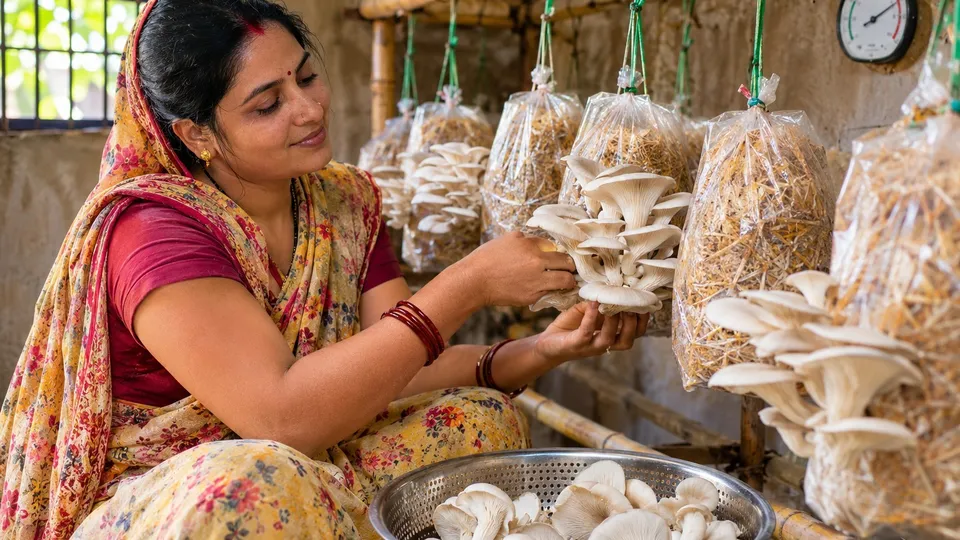 Oyster Mushroom Farming at Home: Cost, Earnings and Method
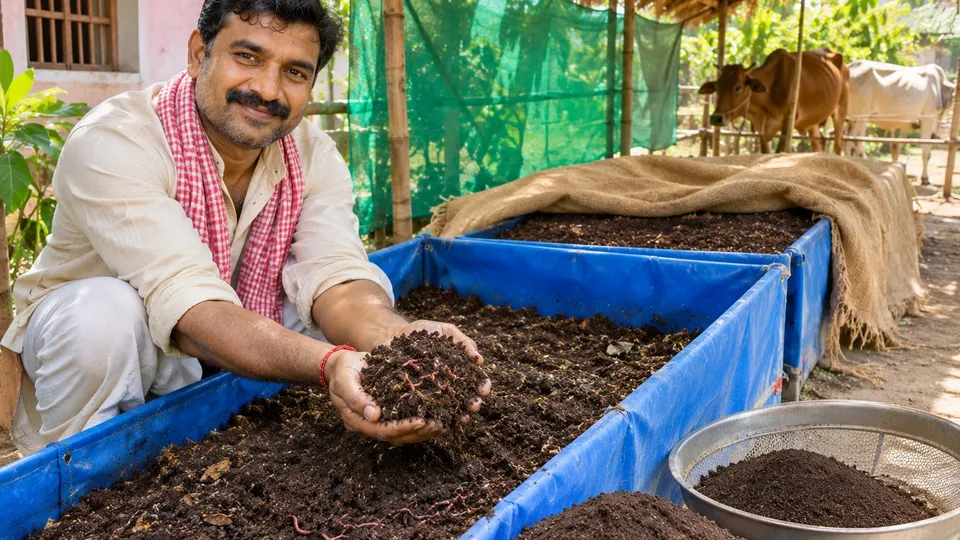 How to Make Vermicompost at Home and Sell It: Method, Cost, Earnings
 Ornamental Fish Farming at Home: How to Start, Cost & Real Income
